
Freight Forwarding Software in Gandhidham, Kandla & Mundra: Managing Shipments, Billing and Operations in One Place
Freight forwarding involves much more than arranging the movement of cargo. A single shipment can involve customer details, import or export information, freight charges, expenses, invoices, documents, payments, party ledgers and operational follow-ups.
For a small forwarding office, managing this information through Excel may work initially. As shipment volume increases, however, information often gets scattered between Excel sheets, accounting software, WhatsApp, emails and document folders.
This creates a common problem: the information exists, but finding the right information at the right time becomes difficult.
This is where freight forwarding software can make a practical difference.
For freight forwarders and CHA companies operating around Gandhidham, Kandla and Mundra, a system designed around the actual forwarding workflow can bring shipment, billing and financial information together without making day-to-day operations unnecessarily complicated.
Why Freight Forwarders Outgrow Excel
Excel remains useful for many businesses, especially when the number of shipments is small.
The difficulty begins when different employees start maintaining different files for:
- Import and export shipments
- Freight and other charges
- Expenses and costs
- Customer billing
- Party ledgers
- Outstanding amounts
- Operational tracking
- Reports
- Document references
The same information may then be entered more than once.
A customer may ask for the status of a shipment, and an employee may need to check one file for the shipment, another for billing, another for outstanding and a folder for documents.
The problem is not necessarily Excel itself. The problem is disconnected information.
A good freight forwarding ERP should reduce this fragmentation by making the shipment the central reference for related operational and commercial information.
What Should Freight Forwarding Software Manage?
The most useful forwarding software is not necessarily the one with the largest number of features. It is the one that follows the company's actual workflow.
A practical system should connect:
Shipment → Revenue & Cost → Billing → Invoice → Party Ledger → Outstanding → Reports
It should also make related documents and references easy to locate. For example, when an employee searches for a shipment, they should be able to access the relevant customer, charges, billing and other information without searching through multiple independent systems. This can save time every day, particularly when the number of shipments and customers starts increasing.
Import & Export Shipment Management
Freight forwarders commonly manage both import and export shipments, each with its own operational requirements.
A shipment management system can provide a structured place for maintaining shipment information, customer details, references, charges, expenses, billing and related documents. The advantage is not simply having a digital record.
The bigger advantage is being able to connect the operational record with the financial and commercial information generated from that shipment.
That makes it easier to answer questions such as:
- What information was recorded for this shipment?
- What charges were associated with it?
- Has it been billed?
- What is the customer's outstanding amount?
- Where can the related reference or document be found?
Freight Forwarding Billing and Cost Tracking
Billing is one of the areas where duplicate data entry can become a major source of wasted time. A forwarding transaction may involve freight, handling, documentation, local or other applicable charges, along with various expenses. When revenue and costs are maintained separately from shipment information, checking a transaction later becomes harder.
A connected workflow is much simpler:
Shipment → Revenue/Charges → Cost/Expenses → Invoice
This also makes it easier to investigate an invoice when a customer asks about a particular charge.
Party Ledger and Outstanding Tracking
Freight forwarding companies deal with multiple customers and business parties, often with many invoices and payments over time. Maintaining outstanding manually can become difficult as transaction volume grows. A connected party ledger and outstanding system can show transactions, invoices, payments and balances in one place. This is useful not only for accounts staff but also for management and operations teams who may need to understand the financial position of a particular customer before following up on a shipment or payment.
Fast Search and Document References Matter
One of the most useful features of a forwarding system is often one of the simplest: search.
Employees may need to find a transaction using a shipment reference, party name, invoice number or another document reference. Instead of remembering which Excel file contains the information, they can search within the system and start from the relevant transaction. This becomes especially valuable when dealing with older shipments.
A structured system changes the process from:
“Which file should I open?” to: "What information am I looking for?"
That is a small difference in theory, but a significant one in daily office work. Freight Forwarding Software in Gandhidham, Kandla and Mundra.
The freight forwarding ecosystem around Gandhidham, Kandla and Mundra involves a wide range of businesses handling import, export, customs, transportation and cargo-related activities. For companies operating in this region, software needs to be practical enough for real forwarding operations. A freight forwarding office may need to manage shipments while simultaneously handling billing, customer outstanding, documentation and communication. That is why a dedicated freight forwarding ERP in Gandhidham or freight forwarding software in Mundra and Kandla can be more relevant than a generic business management system. The important factor is not where the software is developed. It is whether the system understands how a forwarding company actually works.
Freight Forwarding ERP vs Accounting Software
Accounting software and freight forwarding software solve different problems. Accounting software is primarily concerned with financial accounting. A forwarding ERP, on the other hand, can manage the operational information surrounding the shipment. For example, an accounting system may show that a customer has an outstanding balance. A forwarding system can help connect that balance to the underlying shipments, invoices and charges. This is why companies already using accounting software such as Tally do not necessarily need to replace it. Integration can often be a more practical approach.
Tally, WhatsApp and E-Invoice Integration
A forwarding company may already depend on several tools. Replacing everything is not always necessary. For this reason, integrations can be valuable.
Tally Integration
Operational and billing information can be connected with an existing Tally-based accounting workflow.
WhatsApp Integration
Selected communication processes can be connected with business operations, reducing repetitive manual work.
E-Invoice Integration
Billing workflows can be connected with electronic invoicing requirements where applicable. The purpose of integration should always be simple: reduce duplicate work rather than introduce another system to maintain. Freight Pilot ERP for Freight Forwarding Companies.
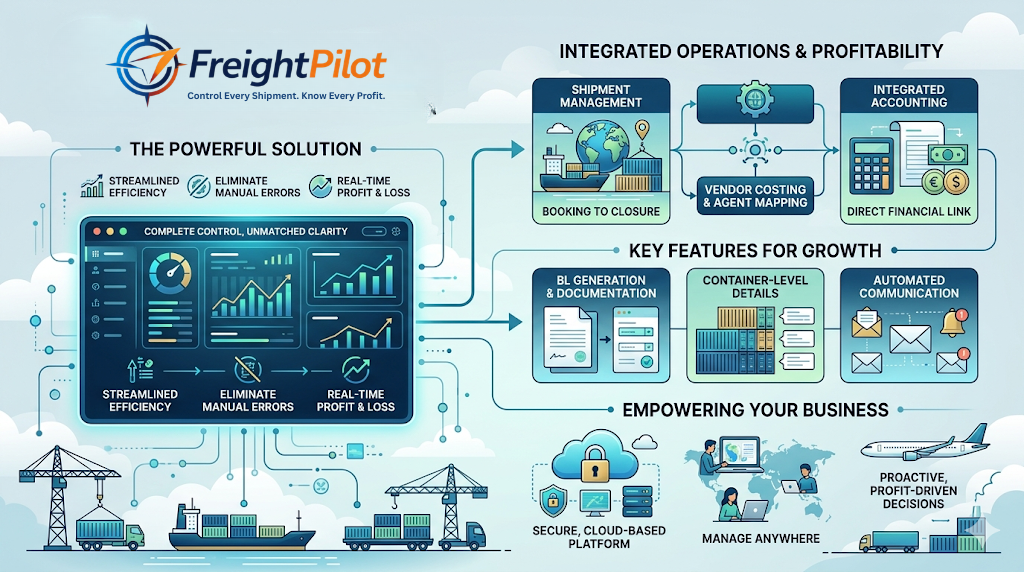
Freight Pilot ERP is designed around the daily workflow of freight forwarders, CHA companies and related businesses.
Instead of maintaining separate records for shipments, billing, party ledgers and operational reports, the system brings these activities together.
Core features include:
- Import / Export Shipment Management
- Invoice & Billing
- Revenue & Cost Management
- Party Ledger
- Outstanding Tracking
- Multiple Users with Access Control
- Multi-Company Support
- Reports & Operational Tracking
- Fast Search
- Document References
The focus is on keeping the system practical for small and mid-size companies rather than making everyday forwarding operations unnecessarily complicated.
Configure the Software Around the Company
Not every freight forwarding company follows exactly the same process. Different companies may have different billing practices, internal responsibilities and operational requirements.
Freight Pilot ERP therefore supports a company-specific setup, allowing the system to be configured according to the company's workflow. This makes the transition from Excel or manual processes more practical because the objective is not to force the company to completely change how it works.
A Practical Alternative to Manual Forwarding Operations
Moving from Excel to dedicated freight forwarding software does not have to mean implementing a complicated enterprise system. For many small and mid-size forwarding companies, the immediate objective is much simpler:
Keep shipment information organized.
Reduce duplicate entry.
Connect billing with operations.
Track party outstanding.
Find information quickly.
Generate useful reports.
Once these fundamentals are handled properly, additional capabilities can be introduced when the business actually needs them. Freight Pilot ERP follows this approach, with optional Tally, WhatsApp and E-Invoice integrations and the ability to add further functionality as required.
Conclusion:
The biggest challenge for a growing freight forwarding company is often not the amount of information it generates, but the number of places where that information is stored.
Excel, accounting systems, WhatsApp, emails and document folders can all be useful individually. The difficulty comes when employees have to constantly move between them to understand one shipment or customer.
A practical freight forwarding ERP brings the important parts of the workflow together:
Shipment → Charges & Costs → Billing → Invoice → Ledger → Outstanding → Reports
For freight forwarding and CHA companies in Gandhidham, Kandla, Mundra and the wider Kutch region, this can provide a more organized way to manage daily operations while keeping existing workflows and tools where they still make sense.
Freight Pilot ERP is built with this practical requirement in mind—a centralized system for managing forwarding operations, billing and party information, with additional integrations available when required.
For Demo, Contact us or whatsapp